
Crypto Airdrop Risk: How to Evaluate Tokens Before You Claim
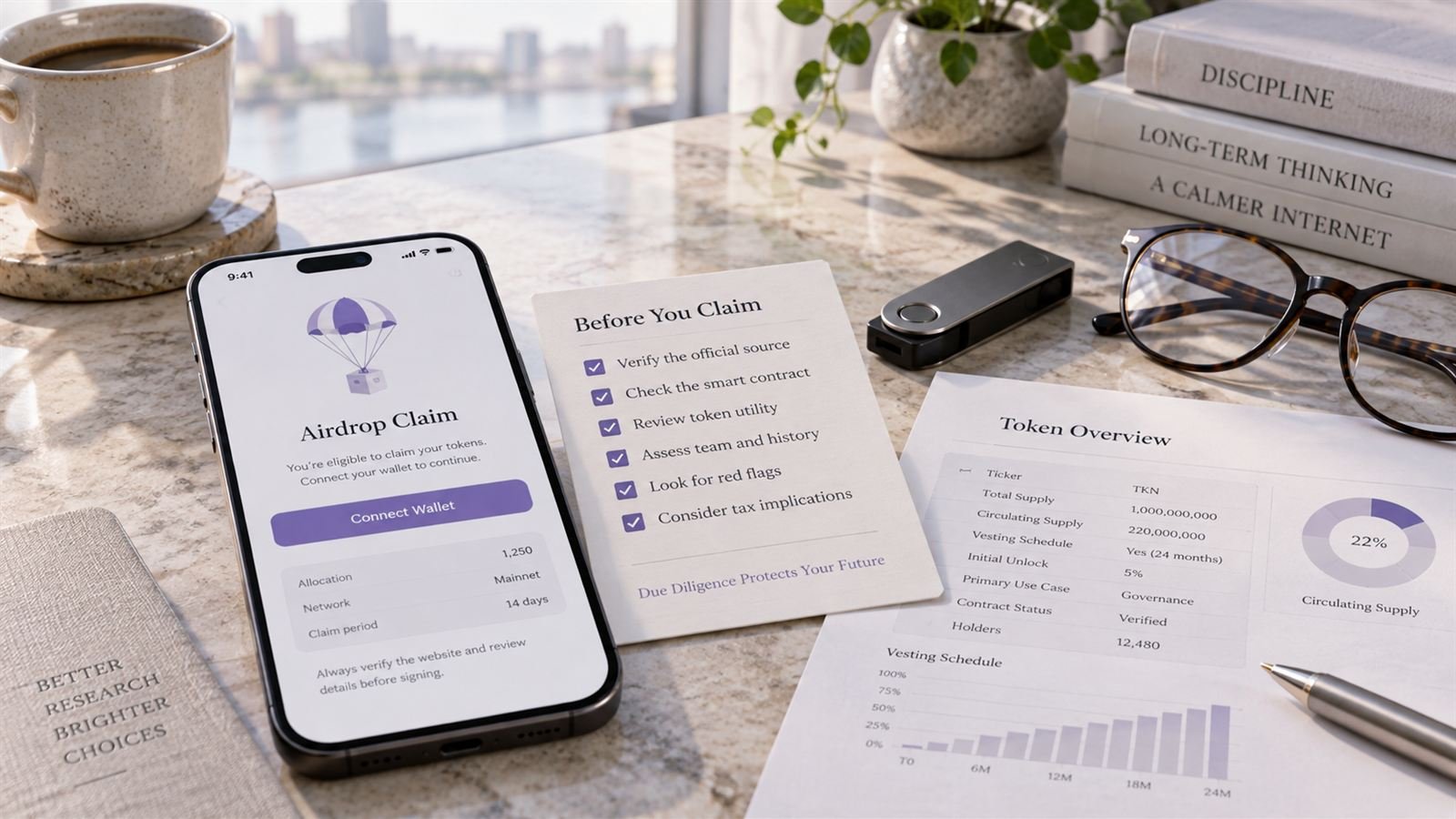
A crypto airdrop can look simple from the outside. A project distributes tokens, users complete a claim, and the tokens appear in a wallet. The real process is often more complicated. The claim may involve a website, a wallet connection, a signature, a smart-contract approval, eligibility rules, token supply assumptions, and a decision about whether the asset is worth holding at all.
That makes crypto airdrop research different from checking whether a token is “free.” The cost can show up somewhere else: a malicious approval, a compromised wallet, a fake domain, unexpected tax consequences, thin liquidity, a concentration of supply, or hours spent chasing a campaign with little economic value.
The risk is not theoretical. In June 2025, the FBI warned that criminals were using NFT airdrops disguised as rewards to direct users toward malicious links and collect credentials or wallet access. In its 2026 crypto crime reporting, Chainalysis estimated that scams received at least $14 billion on-chain in 2025 and projected the figure could rise above $17 billion as more illicit addresses were identified. Those totals cover many scam types, not airdrops alone, but they show the scale of the environment in which airdrop scams operate.
A sensible approach is therefore to treat every airdrop as two separate questions. First: is the claim process safe enough to interact with? Second: even if it is legitimate, is the token economically worth your attention?
Key Takeaways
Seven checks do most of the work before any claim.
- Start With Source Authenticity: Confirm the project, domain, social accounts, token contract, and claim announcement through official channels before connecting a wallet.
- Separate Legitimacy From Value: A real token can still have poor liquidity, concentrated ownership, weak demand, or unfavorable unlocks.
- Treat Wallet Permissions as a Security Decision: A signature or approval can matter more than the market value of the tokens being claimed.
- Use a Segmented Wallet Setup: Keeping airdrop activity separate from long-term holdings can reduce the amount at risk if a claim is malicious.
- Check the Economic Design: Supply, circulating supply, unlock schedules, holder concentration, liquidity, and use case help determine whether the reward has durable value.
- Ignore Urgency: A legitimate claim does not become safer because a countdown timer says it expires in ten minutes.
- Do Not Share Recovery Credentials: No legitimate airdrop needs your seed phrase or private key.
The same Chainalysis report found that the average scam payment rose from $782 in 2024 to $2,764 in 2025. Fewer, larger losses are harder to absorb, which is one more reason to slow down before a claim.
A Crypto Airdrop Has More Than One Kind of Risk
Airdrops are often discussed as if the only danger is an obvious fake. That is too narrow. The useful way to evaluate a crypto airdrop is to separate risk into layers.
| Risk Layer | Question to Ask | Typical Failure |
|---|---|---|
| Source risk | Is this really the project’s claim? | Cloned website or fake social account |
| Wallet risk | What am I signing or approving? | Token approval or wallet drainer |
| Token risk | Is the contract and token authentic? | Fake token using a real project name |
| Market risk | Can the token be sold at a reasonable price? | Thin liquidity or severe slippage |
| Supply risk | Who controls the supply and when do tokens unlock? | Insider concentration or large unlocks |
| Operational risk | How much of my wallet is exposed? | Main wallet connected to an unsafe dApp |
| Economic risk | Is the reward worth the time and gas? | Low-value claim after fees and effort |
This framework matters because a project can pass one layer and fail another. A verified project may distribute a token with poor economics. A valuable token may be impersonated by a fake claim page. A safe website may still ask for a permission the user does not understand.
That is why “Is this a scam?” is only the first screening question.
Verify the Airdrop Before You Connect a Wallet
The safest claim is the one you can independently connect to an official project announcement.
Start from a source you already trust rather than from the claim link itself. If a token appears unexpectedly in your wallet, do not use the URL embedded in the token name, memo, NFT image, or description as proof that the reward is legitimate. The FBI’s 2025 warning described exactly this pattern: criminals used airdrop-style rewards and malicious links to push users toward websites that requested sensitive information or wallet connections.
The same rule applies to social media. A verified-looking profile, paid advertisement, Telegram message, Discord post, or search ad is not enough on its own. Attackers can clone branding and use compromised accounts.
Before doing anything, verify at least four points:
- The project’s official website lists the claim or campaign.
- The project’s official social channels reference the same domain.
- The contract address matches a source controlled by the project.
- The claim timeline and eligibility rules match across those sources.
If any of those conflict, stop.
A legitimate-looking design is not evidence. Consistency across independent official sources is.
Check the Domain, Not Just the Logo
Phishing pages succeed because they reduce a user’s attention to visual familiarity. A copied logo, matching colors, and a familiar wallet button can make a fake site feel authentic.
Domain inspection is therefore a basic security control. Look for misspellings, added words, different top-level domains, unusual subdomains, or characters that look similar to letters in the real domain.
Also check how you arrived there. A link posted in a reply thread is not equivalent to a link published on the project’s official site. A search result marked as an advertisement should not automatically be trusted simply because it appears above organic results.
For high-value claims, open the project website manually from a known bookmark or independently typed address, then navigate to the claim page from there.
That extra minute can prevent a wallet-level mistake that cannot be reversed.
Understand What the Wallet Is Asking You to Sign
Many users focus on transaction fees and ignore permissions. That is backwards.
A gas fee is visible. A harmful approval may be more consequential.
Crypto drainers commonly rely on social engineering that persuades users to connect a wallet and approve a transaction or permission they do not fully understand. Chainalysis describes crypto drainers as phishing tools designed for web3 that can entice users to connect a wallet and grant permissions allowing funds to be moved.
Before signing, identify the action. It may be a wallet connection, a message signature, a token approval, an NFT approval, a permit, a token transfer, a contract interaction, or a transaction granting broad spending rights.
If your wallet simulation or security tool shows an unexpected transfer, unlimited approval, unfamiliar contract, or permission affecting valuable assets, do not continue merely because the page says the step is required.
The economic value of the airdrop should never determine how much permission you grant to an unknown contract.
Use a Separate Wallet for Airdrop Activity
A useful operational rule is to separate exploration from storage.
If your main wallet contains assets you intend to hold, it does not need to be the wallet you use for every new protocol, claim page, testnet, mint, or airdrop.
A segmented setup can include a long-term storage wallet, a regular DeFi or transaction wallet, and a low-balance wallet used for experimental interactions or airdrop claims.
This does not make a malicious transaction safe. It limits the amount that may be exposed if something goes wrong.
The FBI has previously recommended using a unique wallet for higher-risk crypto activities in order to isolate primary holdings if a malicious application gains access. The principle applies well beyond gaming or NFTs: reduce the number of valuable assets that sit behind permissions granted to unfamiliar applications.
Review Existing Token Allowances
A claim does not end when the tokens arrive.
If you granted a contract permission to spend another token, that approval may persist. Users who interact with many DeFi applications can accumulate a long list of allowances over time.
Review allowances periodically and revoke permissions you no longer need. Be careful, however, about using random “revoke” sites found through search or social media. The revocation tool itself should come from a trusted source.
The goal is simple: old permissions should not remain open indefinitely just because they were once convenient.
Confirm the Token Contract
Fake tokens can copy names and tickers. A token called “ABC” does not prove it is the ABC token you expected.
Use the project’s own official documentation to find the contract address, then compare it with what is in your wallet or on a blockchain explorer. Do not rely on symbol alone.
A blockchain explorer can help confirm the contract address, token standard, transaction history, holder addresses, supply information, contract verification status, and transfers associated with the token.
A verified contract does not guarantee investment quality, but contract identity is a basic prerequisite.
Evaluate Holder Concentration
After establishing that the token is real, move from security research to economic research.
One of the first questions is who owns the supply.
If a very small group of wallets controls a large percentage of circulating tokens, those holders may have significant influence on liquidity and price. The analysis becomes harder when one entity uses many wallets, when exchange wallets are counted as holders, or when treasury and vesting contracts are included alongside freely tradable balances.
Holder concentration should therefore be interpreted, not just copied from a dashboard.
Ask which large wallets are exchanges, which belong to the project treasury, which are vesting contracts, which belong to market makers, which appear linked to insiders, and how much of the supply is liquid.
A top-holder table is useful only when wallet roles are understood.
Circulating Supply Matters More Than the Headline Supply Number
Crypto projects can report several supply figures: maximum supply, total supply, circulating supply, and fully diluted valuation based on future supply.
Those numbers answer different questions.
A token with a small circulating float can trade at a high price even if a large amount of supply is scheduled to enter the market later. That future issuance can change the supply-demand balance.
When evaluating a crypto airdrop, examine the relationship among current market capitalization, circulating supply, future unlocks, and the fully diluted value implied by the token price.
The purpose is not to predict where the price will go. It is to understand how much of the eventual supply is already tradable.
Read the Unlock Schedule
An airdrop can create the appearance of broad distribution while a much larger pool of tokens remains allocated to investors, contributors, a foundation, or ecosystem incentives.
An unlock schedule helps explain when those tokens become transferable.
Look for cliff dates, linear vesting periods, investor allocations, team allocations, treasury reserves, ecosystem incentives, and future community distributions.
A large unlock does not automatically cause a price decline. It does increase available supply or the amount that may become sellable, which makes it relevant to risk analysis.
The key is to understand the schedule before treating the current circulating market capitalization as the whole story.
Liquidity Can Matter More Than the Displayed Token Price
A dashboard price can create false confidence.
If only a small amount of liquidity exists near the quoted price, a holder may not be able to sell a meaningful position without moving the market.
Consider a token priced at $1. A wallet showing 5,000 tokens may display a value of $5,000. That does not mean there is enough executable liquidity to sell all 5,000 near $1.
Check trading volume, liquidity pool depth, number of active venues, concentration of liquidity, bid-ask spread on centralized exchanges, slippage on decentralized exchanges, and whether markets are organic or thin.
This is where broader digital asset research becomes useful. Price alone is one field in a larger market structure that includes liquidity, supply, custody, investor behavior, and token economics.
Compare Market Cap With Fully Diluted Valuation Carefully
Fully diluted valuation, or FDV, is often treated as a shortcut for “future market cap.” That interpretation needs caution.
FDV generally applies the current token price to a larger supply figure, often maximum or fully diluted supply. It does not tell you what the token will be worth when all of that supply is circulating.
Still, the gap between circulating market cap and FDV can highlight how much future supply is excluded from today’s circulating capitalization.
A large gap should trigger more research into unlocks, emissions, vesting, and who receives the future tokens.
It is a diagnostic metric, not a forecast.
Check Whether the Token Has a Reason to Exist
Airdrops can create demand temporarily because users expect a reward. That is different from demand for the token itself.
Ask what the token does after distribution.
Possible functions include governance, fee discounts, staking, network security, collateral, protocol incentives, access rights, or value capture from a network.
None of these automatically makes a token valuable. The important question is whether the mechanism creates durable demand or simply adds another reason to issue tokens.
Governance tokens deserve special scrutiny. Voting rights matter only if governance controls something economically or operationally meaningful and if voting power is not so concentrated that small holders have negligible influence.
Measure the Real Cost of “Free”
An airdrop may have no purchase price and still carry costs.
Possible costs include:
| Cost | Example |
|---|---|
| Network fees | Gas paid to claim or bridge |
| Time | Weeks of task completion or monitoring |
| Capital opportunity cost | Funds deposited to qualify |
| Smart-contract risk | Capital exposed in a protocol |
| Bridge risk | Assets moved across chains |
| Privacy cost | Wallet activity tied to identity or accounts |
| Tax cost | Jurisdiction-dependent tax treatment |
| Slippage | Loss when converting a thinly traded token |
A simple net-value calculation is more useful than the headline reward:
Net Airdrop Value = Realizable Token Value - Claim Costs - Conversion Costs - Other Direct Costs
“Realizable” is the important word. Use a price you could plausibly execute at, not necessarily the most optimistic dashboard quote.
Beware of Eligibility Checkers
Eligibility pages are attractive targets for phishing because users are already primed to connect a wallet.
A legitimate checker should not need a recovery phrase. Be suspicious if the site requests private information unrelated to proving wallet eligibility.
Remember that a public wallet address is enough for many legitimate eligibility checks. A project may need a signature to verify wallet control, but the wallet interface should clearly describe what is being signed.
If the signature message is opaque or the domain is uncertain, do not proceed.
Avoid “Pay First to Receive the Airdrop” Traps
Some legitimate claims require network fees. That is different from being told to send cryptocurrency to an address in order to unlock a reward.
Any request to transfer funds to a stranger or “verification wallet” should be treated as a major warning sign.
The same applies to unexpected support agents offering to fix an eligibility problem for a payment.
Scammers often add a second fraud layer after a victim loses money by pretending they can recover the stolen funds.
Do Not Let Social Proof Replace Verification
A Telegram group with thousands of members can be fake. Replies saying “worked for me” can be automated. Screenshots can be fabricated. Influencers can be impersonated.
Social proof can help you discover a claim, but it should not be the basis for trusting it.
A better hierarchy is:
- official project sources;
- verifiable contract data;
- reputable blockchain data;
- independent security research;
- community discussion.
Community excitement belongs at the bottom, not the top.
A Practical Crypto Airdrop Due-Diligence Workflow
Use the same sequence every time so excitement does not change your standards.
Step 1: Verify the Announcement
Find the campaign through official project channels. Confirm dates, eligibility, domain, and contract information.
Step 2: Inspect the Claim Domain
Check spelling, certificate status, redirects, and whether the domain is linked from the official website.
Step 3: Use the Right Wallet
Avoid connecting a storage wallet containing unrelated assets. Use a low-balance wallet when practical.
Step 4: Simulate or Read the Transaction
Understand what the claim asks your wallet to approve. Do not sign permissions you cannot explain.
Step 5: Confirm the Token Contract
Match the address against official documentation and a trusted explorer.
Step 6: Review Token Economics
Check circulating supply, total supply, future unlocks, holder concentration, and liquidity.
Step 7: Estimate Realizable Value
Calculate the amount you could reasonably sell after fees and slippage.
Step 8: Clean Up Permissions
Review approvals after the claim and revoke unnecessary permissions through a trusted tool.
This process is slower than clicking “claim,” but it turns airdrop participation into a repeatable security and investment decision.
Red Flags That Should Stop the Claim
A single red flag may be enough to walk away.
Stop if you see a request for a seed phrase or private key, pressure to send funds to unlock a reward, a domain that differs from the official project domain, a wallet transaction showing an unexpected asset transfer, unlimited approvals with no clear reason, support agents contacting you first, a token contract that cannot be matched to official sources, unexplained urgency, a claim promoted only through replies or direct messages, and a website that blocks inspection or hides basic project information.
The point is not to prove that every unusual claim is fraudulent. It is to refuse interactions when the downside is unclear.
Frequently Asked Questions
These questions cover the points readers most often need to verify before acting on the information above.
Are Crypto Airdrops Legitimate?
Yes. Real projects use airdrops to distribute tokens, reward users, decentralize ownership, or attract attention. The existence of legitimate airdrops is also why scammers imitate them.
Can an Airdrop Drain My Wallet?
Receiving a token by itself does not necessarily drain a wallet. The risk often appears when a user follows a malicious link, connects a wallet, or signs a harmful approval or transaction.
Should I Use My Main Wallet for Airdrops?
A separate low-balance wallet can reduce the amount of unrelated assets exposed to experimental claims and applications. It does not replace transaction verification.
Is a Verified Smart Contract Safe?
Verification makes contract code easier to inspect but does not guarantee that the contract is safe, economically sound, or free from malicious logic.
How Do I Know Whether an Airdropped Token Has Value?
Check liquidity, trading venues, circulating supply, holder concentration, unlock schedules, token use, and the price you could realistically execute.
Can I Ignore an Unknown Token in My Wallet?
Often, yes. Unexpected tokens do not need to be interacted with. If the token contains a suspicious URL, do not follow it simply to investigate the reward.
Resources
The following sources provide the primary evidence used to verify the claims and frameworks above.