
Top Rated Stock Screener Comparison: Data, Filters, and Research Tools
 By Darlene Aberin Updated
A stock screener becomes useful when it removes companies that do not fit an investment thesis before deeper research begins. The strongest tools do more than return a list of tickers. They let investors combine valuation, profitability, growth, balance-sheet, ownership, price, and technical filters in ways that reflect how they invest.
That is why the top rated stock screener for one investor can be the wrong tool for another. The answer depends on the job. Finviz is built for fast U.S. equity screening and visual market scans. Koyfin goes deeper into global fundamentals and estimates. Morningstar Investor combines screening with independent research and portfolio analysis. TradingView is strongest when technical conditions and charting come first. Yahoo Finance offers a more accessible starting point for general investors.
The useful comparison is therefore not which top rated stock screener has the most filters. It is which one helps an investor move from a large market universe to a smaller list of companies worth researching without introducing unnecessary complexity or cost.
Key Takeaways
- Finviz is strongest for fast U.S. equity screening, market maps, signals, and practical filtering.
- Koyfin is a better fit for investors who need global fundamentals, analyst estimates, historical data, custom dashboards, and deeper research after screening.
- Morningstar Investor combines screening with analyst research, ratings, and portfolio context.
- TradingView is the strongest option for chart-heavy, technical, and alert-driven screening workflows.
- Yahoo Finance remains a practical low-friction option for investors who need quotes, news, portfolio monitoring, and simpler screens.
- Finviz Elite costs $299.50 per year, or about $24.96 per month, while Koyfin Plus costs $39 per month on annual billing.
- Morningstar Investor costs $249 per year, TradingView Essential starts at $12.95 per month on annual billing, and Yahoo Finance Bronze works out to $7.95 per month on annual billing.
- A stock screener should narrow the research universe, not replace fundamental analysis, valuation work, or risk assessment.
What Makes a Stock Screener Worth Using?
A stock screener is essentially a filtering engine. It starts with a broad universe and removes securities that do not meet chosen criteria. The quality of the output depends on the quality of the filters and whether they reflect a real investment process.
An investor looking for profitable compounders may combine revenue growth, operating margin, return on equity, debt, and valuation. A value investor may begin with cash flow, earnings multiples, and balance-sheet strength. A trader may care more about volume, moving averages, relative strength, and price breakouts.
The screener becomes more useful when several measures are interpreted together. A low P/E ratio can indicate value, but it can also signal weak growth or deteriorating fundamentals, which is why stock analysis fundamentals follow the screen. Combining stock screener metrics such as valuation, profitability, growth, leverage, and risk usually produces a more informative shortlist than ranking companies on one ratio alone.
How the Leading Stock Screeners Compare in 2026
The platforms below cover different parts of the screening workflow. Pricing reflects public plan information checked October 12, 2026 and can change with promotions, billing choices, taxes, or future plan updates.
| Platform | Best For | Free Plan | Selected Paid Entry Point | Main Advantage |
|---|---|---|---|---|
| Finviz | Fast U.S. stock screening | Yes | $299.50/year | Fast filters, market maps, signals |
| Koyfin | Deep fundamental screening | Yes | $39/month billed annually | Global data, estimates, research depth |
| Morningstar Investor | Long-term research | Limited | $249/year | Analyst research, ratings, portfolio context |
| TradingView | Technical screening | Yes | $12.95/month billed annually | Charts, technical filters, alerts |
| Yahoo Finance | General investor research | Yes | $7.95/month billed annually | Accessibility, quotes, news, portfolio tools |
The price range is wide because these tools are not identical substitutes. A lower-cost platform can be the better choice when it matches the investor's workflow, while a more expensive platform can still offer better value if it replaces several separate tools.
Finviz Is the Fastest Route From Market to Shortlist
Finviz is built around speed. Its screener combines descriptive, fundamental, ownership, performance, and technical filters in a compact interface that makes it easy to move through a large U.S. equity universe.
The free version already supports broad stock screening, and it features in the guide to the best stock screener for free. Finviz Elite adds real-time market data, more advanced filters, unlimited saved presets, alerts, exports, eight years of financial statements, and expanded charting.
According to Finviz's current Elite pricing, the subscription costs $39.50 per month or $299.50 per year, which works out to about $24.96 per month on annual billing.
Where Finviz Has an Edge
Finviz works particularly well for investors who know the factors they want to screen. Filters can quickly narrow the market by valuation, profitability, growth, volume, ownership, performance, and technical conditions.
Its visual maps also add context after the screen. A list of cheap semiconductor companies looks different when the entire industry is falling, while a stock near a technical breakout may deserve different treatment from one rising only because the whole sector is strong.
Where Finviz Is Less Complete
Finviz is optimized around U.S. markets and fast screening rather than deep global fundamental research. Investors who need long financial histories, global coverage, analyst-estimate workflows, or complex portfolio analytics may outgrow it. For those needs, Finviz works best as a first filter, with a second tool used for the detailed company research that follows.
Koyfin Goes Deeper After the Screen
Koyfin treats screening as one part of a larger research workspace. It combines global equities, financial statements, analyst estimates, charts, macro data, watchlists, dashboards, filings, and portfolio tools.
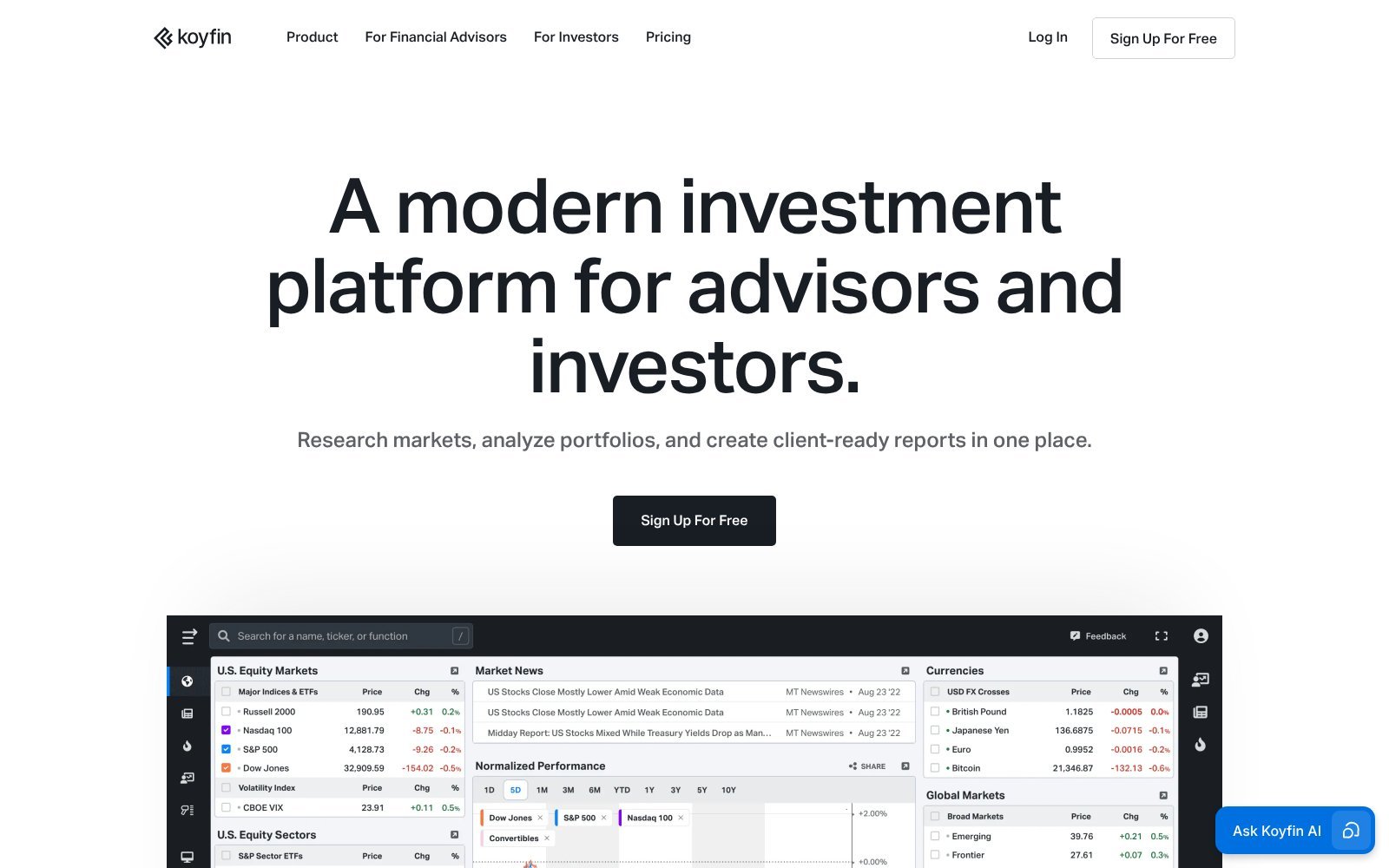
The free plan includes two years of financial data, one year of estimates, two screens, and limited dashboards. Koyfin's 2026 pricing lists Plus at $39 per month when billed annually and Premium at $79 per month.
Where Koyfin Has an Edge
Koyfin's advantage is depth. The Plus plan includes ten years of financials and estimates, unlimited watchlists and screens, ETF holdings, more than 100,000 global company snapshots, company filings, press releases, and transcripts.
That reduces the need to move between a screener and a separate research platform. An investor can identify candidates, review financial history, inspect estimates, and compare peers without rebuilding the analysis elsewhere.
Where Koyfin Is Less Efficient
The depth can be unnecessary for a casual investor whose main need is finding U.S. stocks that meet a handful of simple criteria. In that case, the extra data and dashboard flexibility may not justify the higher subscription cost. With more data and dashboard options to set up, new users may need some time before the extra features save effort.
Morningstar Investor Connects Screening With Research
Morningstar Investor is strongest when screening is only the first stage of a long-term investment process. Its platform combines security screening with analyst ratings, research, fair-value thinking, and portfolio tools.
Morningstar Investor lists annual pricing at $249, equivalent to about $20.75 per month, or $34.95 on monthly billing.
Where Morningstar Has an Edge
The research layer is the differentiator. Morningstar gives investors a way to compare securities and then move into analyst-written work, ratings, valuation views, and portfolio context.
That is particularly useful for investors choosing between several funds or stocks that all pass similar quantitative screens.
Where Morningstar Is Less Specialized
Morningstar is not primarily designed as a rapid technical trading screener. Investors whose workflow depends on intraday patterns, advanced alerts, and chart-based conditions may find TradingView more natural. Its screens are built around long-term research rather than speed, which suits patient investors more than active traders.
TradingView Is Strongest for Technical Screening
TradingView combines screeners with one of the most flexible retail charting environments. Technical traders can filter securities and then immediately examine the underlying price structure, volume, indicators, and alerts.
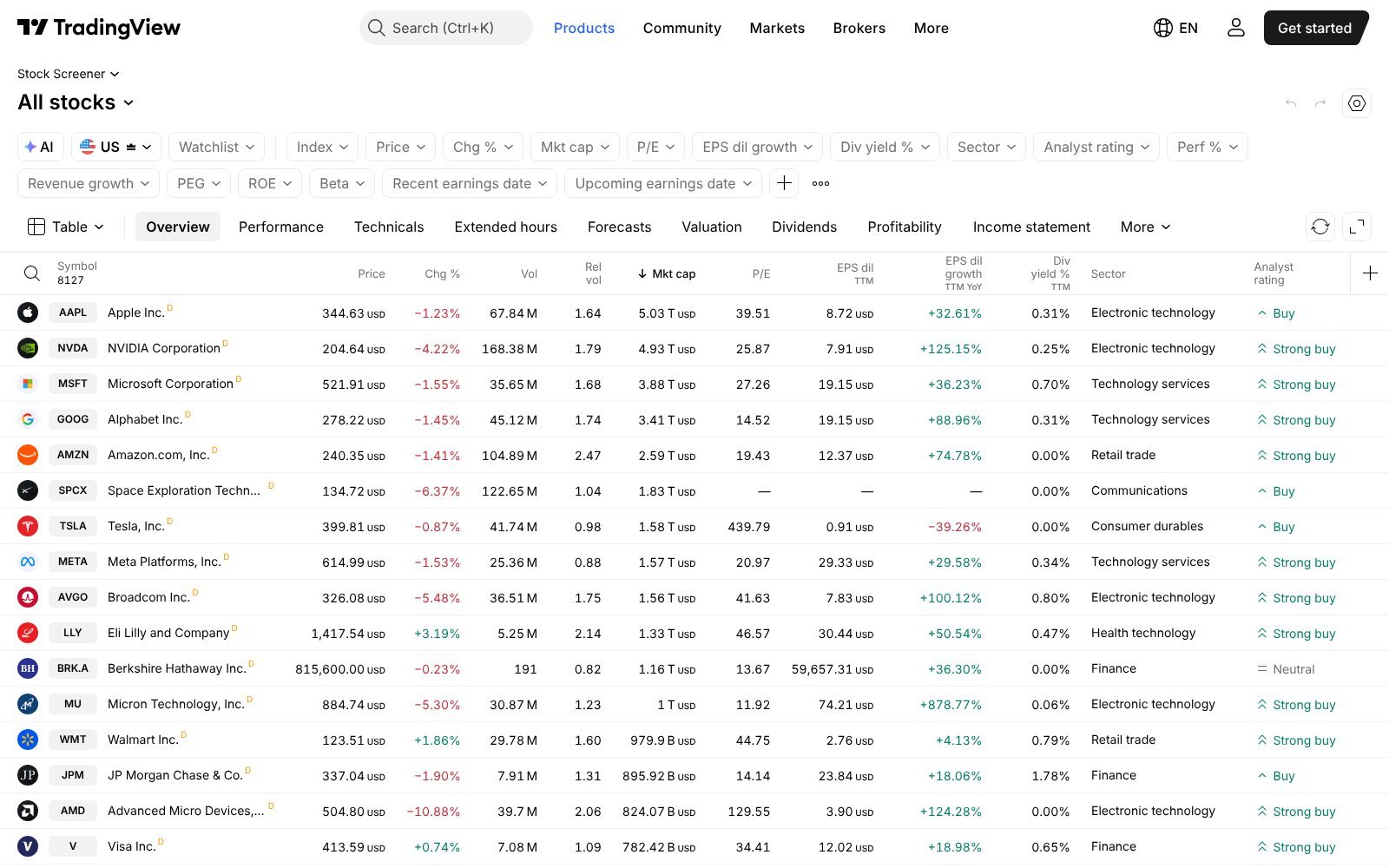
Its free Basic plan covers entry-level use. TradingView's pricing lists Essential at $12.95 per month when billed annually, with higher tiers increasing chart layouts, indicators, alerts, and historical bars.
Where TradingView Has an Edge
TradingView is useful when the screen itself includes technical conditions. Moving averages, momentum, volume, price patterns, and other market-based signals can be examined in the same environment where charts are analyzed.
That makes the platform efficient for traders who need to monitor many securities continuously rather than research a smaller number of companies in depth.
Where TradingView Is Less Complete
TradingView includes fundamental data, but its defining advantage remains technical analysis. Investors who build detailed financial models or compare long histories of company fundamentals may prefer Koyfin or Morningstar. Long-term investors who want many years of statements and estimates in one research workspace may still pair it with a second tool.
Yahoo Finance Is a Practical Starting Point
Yahoo Finance remains useful because it combines quotes, news, financial statements, watchlists, portfolios, screening, and analyst information in a familiar interface.
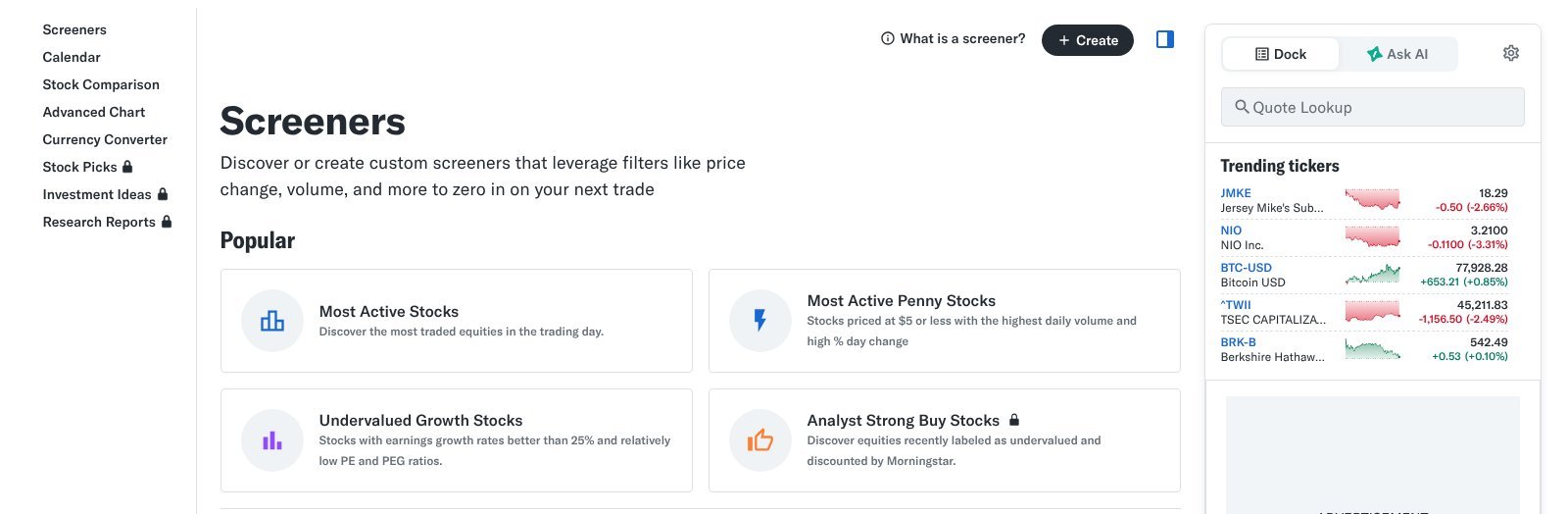
Its core experience is free. Yahoo Finance's plan page prices its paid tiers by the year: Bronze at $95.40, Silver at $239.40, and Gold at $479.40. That works out to $7.95, $19.95, and $39.95 per month. Monthly billing costs more, and first-year promotional prices change often, so the checkout page is the final word.
Where Yahoo Finance Has an Edge
Accessibility is its biggest advantage. An investor can move quickly from a quote into recent news, historical prices, financial statements, estimates, and a watchlist without learning a specialized platform. The free tier also covers a wide range of securities, which makes it a practical place to learn how screening works.
Where Yahoo Finance Is Less Specialized
Its screening and research depth are not as differentiated as the tools above. Advanced users who need custom formulas, institutional-style dashboards, or specialized technical workflows may need another platform. Paid tiers add more data and tools, but the core screener remains simpler than the specialist options covered earlier.
How Entry-Level Paid Pricing Compares
The lowest highlighted paid tiers illustrate how different the cost structures are. These are not equivalent plans, so price should be read together with the features each investor needs.
| Platform | Selected Paid Entry Cost |
|---|---|
| Yahoo Finance Bronze | $95.40/year |
| TradingView Essential | $12.95/month, billed annually |
| Morningstar Investor | $249/year |
| Finviz Elite | $299.50/year |
| Koyfin Plus | $39/month, billed annually |
Every plan above is cheapest on annual billing, so the chart converts each one to a monthly equivalent. That puts the five tools on the same footing for comparison.
The spread is about five to one. Koyfin Plus costs roughly five times as much per month as Yahoo Finance Bronze, yet neither price says much on its own. A top rated stock screener earns its fee only when its features replace work the investor would otherwise do by hand.
Which Screener Fits Each Investing Style?
The strongest choice depends on the work that happens after a stock passes the filter. Investors should choose the platform that minimizes friction between discovery and analysis.
Fundamental Investors
Koyfin is the strongest fit when screening needs to connect with financial statements, estimates, global coverage, and deeper company research. Ten years of financials and estimates on the Plus plan make it easier to check whether a company that passes a screen has held up over time. The extra depth costs more than the simpler tools.
Value and Long-Term Investors
Morningstar Investor works well when quantitative screens need to be combined with analyst research, ratings, and portfolio context. The analyst-written research helps when several companies pass the same screen and the investor needs a reason to look closer at one. The annual plan suits investors who review holdings over months or years.
Fast U.S. Stock Screening
Finviz is difficult to beat for quickly moving from thousands of U.S. stocks to a compact candidate list. The free version already covers broad filtering, and the visual market maps add quick context on sector moves. Investors who need real-time data, alerts, or exports can step up to Elite when those needs appear.
Technical Traders
TradingView is better suited to investors who filter securities by technical conditions and then move directly into charts, alerts, and price behavior. Screens can include conditions such as moving averages, momentum, and volume, and the results open straight into charts. That keeps the gap between finding a setup and studying it very short.
Newer Investors
Yahoo Finance provides enough free information to learn a screening process before paying for specialized data or advanced workflow features. Its familiar layout lowers the learning curve, and quotes, news, and financial statements sit in one place. Once an investor knows which filters they use most, a specialist platform becomes easier to judge.
Free Stock Screeners Are Often Enough to Build a First Process
Paying for a screener should solve a specific constraint. Free access can already support basic filtering, watchlists, charts, and company research on several platforms.
The case for paying becomes stronger when an investor repeatedly needs real-time data, deeper financial history, analyst estimates, exports, more saved screens, custom formulas, or advanced alerts.
A free screener can therefore be the better starting point even when a paid platform is objectively more powerful. The value of a subscription comes from features that change the research workflow, not from the number of features available.
How to Test a Top Rated Stock Screener Before Paying
Most of the platforms above offer a free tier, a trial, or both. A short, structured test shows more than any feature list, and it costs nothing but time.
Rebuild One Screen You Already Use
Pick a screen that reflects a real investing approach, such as profitable companies with low debt and steady revenue growth. Build it on two or three platforms and compare the results. Different ticker lists can point to different data sources, different definitions of a ratio, or different market coverage.
Check the Definitions Behind the Filters
Ratios that share a name can be calculated in different ways. One platform may use trailing earnings for P/E while another uses forward estimates. Debt filters may include or exclude leases. A top rated stock screener should state how each metric is calculated, or at least make the definition easy to find.
Time the Path From Screen to Research
Run the screen, open three results, and look at five years of financial statements for each. Count the clicks and the tools needed. A platform that keeps the whole path in one place can save more time than a cheaper tool that sends the investor elsewhere for every company.
Note What the Free Tier Leaves Out
Write down each moment the free version stops the test, such as delayed data, a limit on saved screens, or missing history. If those limits block the work every week, a paid plan may be worth it. If they rarely appear, the free tier is probably enough.
A Stock Screener Should Narrow the Question, Not Answer It
Screeners are excellent at identifying companies that match predefined rules. They are much less useful at deciding whether those rules capture the economics of a business.
A company can pass a low-debt screen while facing declining demand. It can pass a growth screen because of a temporary acquisition. It can look cheap on earnings while cash flow deteriorates.
That is why screening should be followed by fundamental analysis. The shortlist creates efficiency; the investment case still requires understanding the business, financial statements, valuation, risk, and the assumptions behind future growth.
The Best Screener Is the One That Fits the Research Process
Finviz, Koyfin, Morningstar Investor, TradingView, and Yahoo Finance are all credible stock-screening tools, but they solve different problems. Each can be the top rated stock screener for a particular workflow.
Finviz is the strongest choice for speed. Koyfin adds depth and global context. Morningstar adds analyst judgment and portfolio thinking. TradingView connects screening directly to technical analysis. Yahoo Finance offers a low-friction starting point.
Investors can therefore judge a screener by a simple test: does it help reduce a large market universe into a better research list without adding more noise than insight? If it does, the tool is serving its purpose, and it is the top rated stock screener for that investor.
Frequently Asked Questions
What Is the Best Stock Screener in 2026?
The best choice depends on workflow. Finviz favors fast U.S. screening, Koyfin deep fundamentals, Morningstar research, TradingView technical analysis, and Yahoo Finance accessible general investing tools.
What Is the Best Free Stock Screener?
Finviz, Koyfin, TradingView, and Yahoo Finance all provide useful free access. The strongest choice depends on whether the investor prioritizes fundamentals, charting, speed, or basic research.
Is Finviz Elite Worth Paying For?
Finviz Elite is most useful for investors who need real-time data, advanced filters, unlimited presets, alerts, financial history, and exports. Casual screeners may find the free version sufficient.
Is Koyfin Better Than Finviz?
Koyfin offers deeper global fundamentals, estimates, filings, and dashboards. Finviz is faster for U.S. equity discovery, making each platform stronger for a different stage of research.
Should a Stock Screener Be Used to Pick Stocks Automatically?
No. A screener identifies companies matching selected rules. Investors still need to evaluate financial statements, business quality, valuation, competitive risks, and whether the screening criteria fit the investment thesis.