
Zacks Stock Screener: How the Rank, Screens, and Research Fit Together
 By Darlene Aberin Updated

The Zacks stock screener is built around one distinctive idea: changes in analysts' earnings estimates deserve a central place in stock selection. That makes it different from a neutral filtering tool, where the investor alone decides which numbers count.
Investors can still screen on familiar valuation, growth, profitability, and price data. The platform becomes more distinctive once Zacks' own signals enter the process, including the Zacks Rank, Style Scores, Industry Rank, and a library of predefined Premium Screens. Zacks Premium costs $249 per year after a 30-day trial, according to Zacks' own pages checked on October 15, 2026. This review explains what the Zacks stock screener does, what the paid tier adds, and where the approach has limits.
Key Takeaways
- Zacks says its screening tools let users screen on "virtually any item," including the Zacks Rank.
- Zacks Premium costs $249 per year after a 30-day trial and includes more than 45 predefined Premium Screens.
- Zacks describes its #1 Rank List as the top 5% of stocks in its ranking system.
- Research Wizard, a separate Zacks product, advertises more than 650 screening traits plus strategy backtesting.
- The platform suits investors who want earnings-estimate revisions inside their process.
- Zacks' rankings are its own model, so every result still needs independent checking.
What the Zacks Stock Screener Is Designed to Do
On its screening tools page, Zacks describes the custom stock screener as a way to "screen stocks on virtually any item, including the Zacks Rank." Users can also start from predefined screens instead of building every filter by hand.
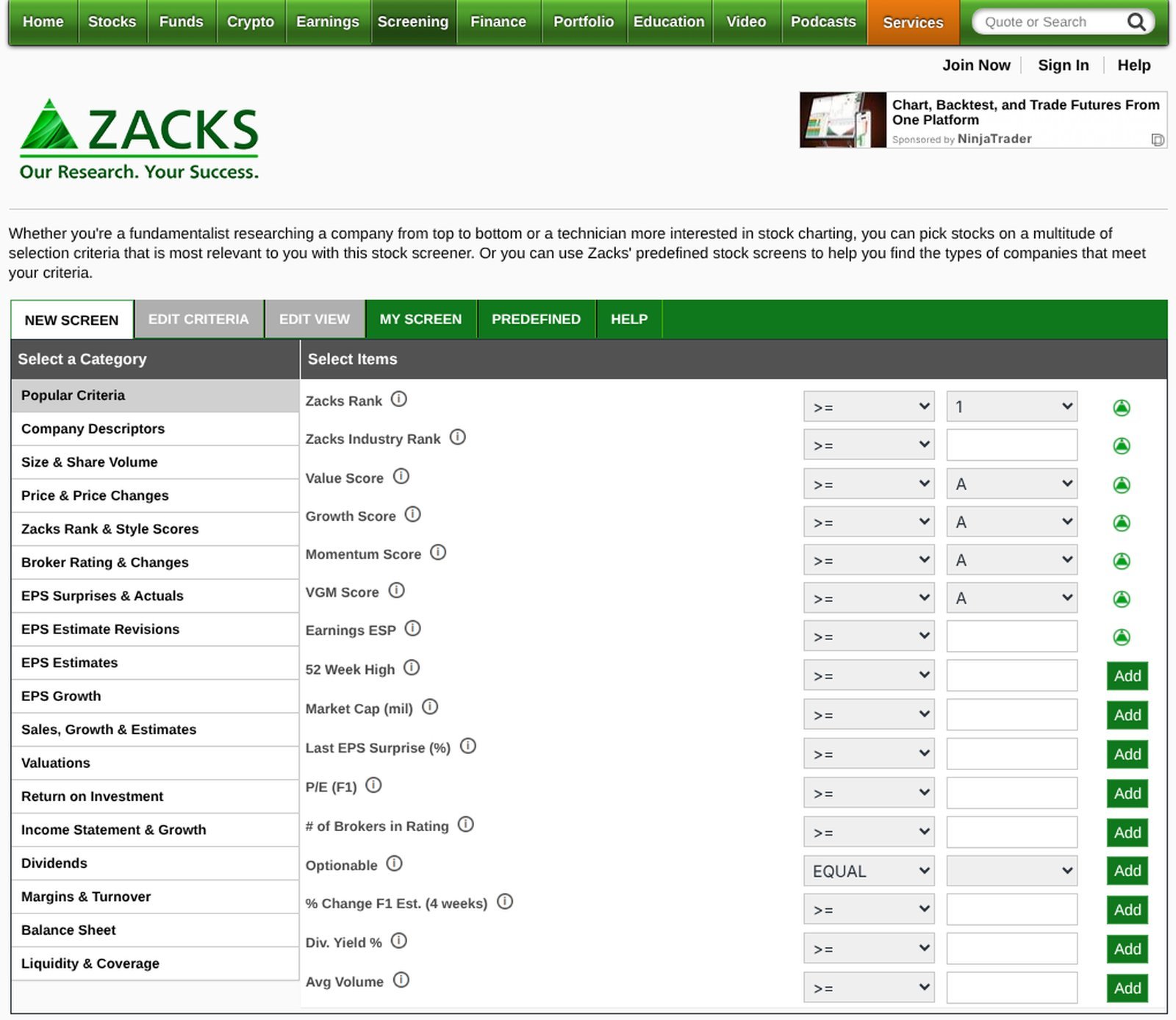
The predefined screens on that page fall into recognizable groups. Some target value, such as stocks with strong Zacks Ranks, Value Style Scores of A or B, and Industry Ranks in the top half. Others target growth, momentum, income, or companies with rising estimates and price targets. The common thread is that most of them blend standard financial filters with at least one Zacks signal.
Custom Screens
A custom screen lets the investor choose each criterion directly. That might mean a price-to-earnings limit, a minimum market capitalization, a dividend yield range, or a required Zacks Rank. The benefit is control. The investor knows exactly why each company passed, which makes the results easier to explain and test later.
Predefined Screens
Predefined screens trade some of that control for speed. Zacks has already chosen the filters and thresholds, so a list appears in seconds. This is useful for exploring ideas. The tradeoff is that the user should open the screen's criteria and understand them before treating the output as a meaningful starting list.
The Zacks Rank Changes the Screening Philosophy
Many screeners are neutral tools. They show the data and leave every judgment to the user. Zacks adds its own ranking system on top, which shifts the process from "what do I want to filter for" toward "what does the model favor right now."
The Zacks Rank places stocks on a five-point scale that runs from #1 (Strong Buy) to #5 (Strong Sell), with #3 as Hold. Zacks says the system is driven by earnings-estimate revisions. In plain terms, it tries to surface companies where analysts' expectations are moving up and flag those where expectations are falling. Zacks describes its #1 Rank List as "the top 5% of stocks" in that universe.
How Zacks Reports Its Own Results
Zacks publishes a performance page for the Zacks Rank. As of October 15, 2026, it reported an average yearly gain of 23.82% for #1 Rank stocks since 1988, against 11.58% annualized for the S&P 500. These are Zacks' own figures for a hypothetical portfolio of #1 Rank stocks, rebalanced monthly and calculated exclusive of fees. They describe a model, not what any investor earned, and past results do not predict future ones.
Why the Rank Labels Need Care
The labels "Strong Buy" and "Strong Sell" are Zacks' names for its model output. They are not advice for any individual. A stock can rank #1 while carrying heavy debt, a stretched valuation, or a business model the investor does not understand. Treating the rank as one input, alongside your own research, keeps it in its proper place.
Style Scores and Industry Rank Add Context
The Zacks Rank is not the only proprietary signal in the screener. Zacks also grades stocks with Style Scores and ranks whole industries, and many predefined screens use all three together.
Style Scores
Style Scores grade stocks on value, growth, and momentum characteristics, with a combined VGM score. Zacks' screens often require a Style Score of A or B. For example, its Zacks #1 Rank lists can be narrowed to stocks with a Value, Growth, Momentum, or Income Style Score of A or B, which helps match a list to an investing style.
Industry Rank
Industry Rank compares industries against each other instead of comparing single companies. Several Zacks screens require a stock to sit in the top 50% of Zacks Ranked Industries. The idea is that a strong company in a weak industry faces more headwinds, so the filter adds a sector-level check to a company-level signal.
Premium Screens Add Ready-Made Strategies
Zacks says its Premium Screens let subscribers "pick & choose from over 45 predefined screens." The library covers value, growth, momentum, income, market-cap, price-target, and bearish approaches.
The main benefit is speed. An investor does not need to design every strategy from a blank page. For someone still learning how screens are built, the predefined versions also show how different filters can be combined into a coherent strategy.
Reading a Screen Before Using It
Every predefined screen has a short description and a set of criteria. Reading both before reviewing the results is the most useful habit a new user can build. It shows which signals are proprietary, which are standard financial measures, and which thresholds might exclude companies the investor would otherwise want to consider.
Adapting a Screen to Your Own Rules
A predefined screen is a reasonable first draft. Many investors adjust it by adding a debt limit, a minimum trading volume, or a sector exclusion. Each change should have a clear reason. Small, deliberate edits produce a list that fits the investor's own process instead of a generic one built for everyone.
Research Wizard Goes Beyond Basic Screening
Research Wizard is a separate Zacks product, sold apart from Zacks Premium. Zacks' own Research Wizard page invites users to "choose from over 650 traits" to screen more than 8,800 stocks, and it adds built-in strategies and backtesting. Older Zacks material cited a figure of over 600, so the exact count has changed over time.
Backtesting lets an investor test how a set of screening rules would have performed in past data. That moves the process beyond filtering today's market. Any backtest is still a simulation, so its results show how rules behaved in one historical sample, not how they will behave next.
What Backtesting Can Show
A backtest can reveal whether a rule set behaved consistently across different periods or depended on one unusual stretch. It can also show how many stocks typically pass the screen, how often holdings changed, and how deep the worst losses were. Those details help an investor judge whether a strategy is practical to run.
Where Backtests Mislead
Backtests are easy to over-tune. Adjusting thresholds until the past looks perfect usually produces rules that fit history and fail afterward. Survivorship bias, changing market regimes, and ignored trading costs can also inflate results. Testing a rule on one period and checking it on another is a sensible safeguard.
Zacks Premium Pricing in 2026
Zacks lists Premium at $249 per year with a 30-day trial. According to Zacks' product pages, the subscription includes full access to the Zacks #1 Rank List, Zacks Equity Research reports, the Focus List portfolio of 50 longer-term stocks, Industry Rank, and more than 45 Premium Screens.
| Feature | Free Zacks Access | Zacks Premium |
|---|---|---|
| Custom stock screening | Available | Available |
| Full Zacks #1 Rank List | Limited | Included |
| Premium Screens | Not included | More than 45 |
| Zacks Equity Research reports | Limited | Included |
| Focus List portfolio | Not included | Included |
| Price | $0 | $249 per year |
Prices were checked on Zacks' pages on October 15, 2026 and can change. Research Wizard and Zacks' trading services are priced separately.
Where the Zacks Stock Screener Is Strongest
The Zacks stock screener stands out most when an investor wants a defined research framework rather than a blank grid of filters. Three use cases show this clearly.
Earnings Revision Strategies
The Zacks Rank is built around changes in earnings expectations. Investors who believe rising estimates often signal improving business conditions get a ready-made way to bring that idea into a screen. Building the same signal from raw analyst data would take far more time and access to paid estimate databases.
Combining Signals in One Pass
Many predefined screens combine the Zacks Rank, a Style Score, and an Industry Rank threshold with standard measures like valuation or dividends. This lets a user test a multi-factor idea in a single step. The investor can then inspect each company to see which factor carried it into the list.
Where Zacks Can Be Less Useful
Zacks is less neutral than a general-purpose screener. Much of its value comes from proprietary scores, so an investor who does not trust or use those signals pays for features they will ignore.
Investors Who Build From Raw Data
Some investors prefer to start from financial statements and their own assumptions. For them, a ranking layer can feel like a distraction. A neutral screener with deep fundamental data may fit better, and many capable free options exist for that style of research. Investors who prefer analyst ratings to rankings can compare the Morningstar stock screener, which builds fair value and competitive-advantage ratings into its filters.
Short-Term Technical Traders
Zacks offers price and volume filters, but its identity centers on earnings and estimates. Traders who live in intraday charts and technical patterns often prefer platforms built around charting first, where indicators, drawing tools, and alerts carry the main workload.
Zacks Compared With Finviz
Finviz is one of the most common comparison points for any screener. The two platforms take different approaches, and the table below reflects their published features and pricing as of October 15, 2026.
| Area | Zacks | Finviz |
|---|---|---|
| Proprietary ranking system | Central to the platform | Not a core feature |
| Earnings-estimate revisions | Core signal | Less central |
| Predefined strategy screens | More than 45 on Premium | Preset filters and signals |
| Paid tier annual price | $249 (Premium) | $299.50 (Elite) |
Zacks works like a research system with a point of view. Finviz works like a fast discovery interface where the user supplies the point of view. If you are still comparing low-cost tools, our roundup of the best stock screener for free options covers Finviz and four other free platforms in more depth.
How to Use Zacks Rank Without Treating It as a Signal to Act
A rank can point toward a company worth investigating. It cannot tell an investor whether that company fits their goals, timeline, or tolerance for risk.
Add Balance-Sheet and Valuation Filters
A company with rising estimates may still carry excessive debt, trade at a demanding valuation, or depend on a few large customers. Adding filters for debt levels, cash flow, and valuation alongside the rank narrows the list to companies where the estimate trend is supported by a sound financial position. Checking that position is the work of stock analysis fundamentals.
Read the Underlying Research
Premium members can open Zacks Equity Research reports for covered companies. Reading why estimates are changing, and whether the change looks temporary or lasting, adds context that a single rank cannot carry. A rank moves when estimates move, but the reasons behind those changes deserve their own review.
A Sample Zacks Screening Workflow
The following routine is one illustrative way to use the platform. It shows how the pieces fit together and is not a recommendation to act on any result.
Step One: Start With a Defined Question
Decide what you are looking for before opening the screener. For example, an investor might want profitable mid-size companies with improving earnings expectations. That question points to a market-cap range, a profitability filter, and a Zacks Rank requirement, which keeps the screen focused.
Step Two: Review and Narrow the List
Run the screen, then sort the results and remove companies outside your circle of knowledge. Check each remaining company's balance sheet, recent results, and research report. A shorter list reviewed carefully is usually more useful than a long list skimmed quickly. Saving the screen also lets you rerun it later and see which companies joined or dropped off.
Questions to Answer During the 30-Day Trial
The trial is the best time to judge whether Premium earns its annual cost.
Do You Use the Rank and Style Scores?
Track how often you open the #1 Rank List, the Style Scores, and the Premium Screens during the trial. If those features become part of your weekly routine, the subscription has a clear role. If you mostly use basic filters, a free screener may cover the same ground.
Do the Research Reports Change Your Decisions?
Open several Zacks Equity Research reports on companies you already follow. Ask whether they add information you did not have. Reports that change how you see a company carry real value, while reports that repeat what you already know make the subscription harder to justify.
The Zacks Stock Screener Fits Investors Who Want a Defined Framework
The Zacks stock screener is more than a filter database. Its strongest features are built around one research philosophy centered on earnings revisions, rankings, style factors, and predefined strategies. That structure helps investors who want more guidance than a blank screening page provides.
The same structure is its main limitation. Investors who prefer to build every judgment themselves may find a neutral screener simpler and cheaper. Testing the platform against your own process during the trial is the clearest way to decide which group you belong to.
Frequently Asked Questions
Is the Zacks Stock Screener Free?
Zacks offers custom screening with a free membership. Full #1 Rank List access, more than 45 Premium Screens, and equity research reports require Zacks Premium.
How Much Does Zacks Premium Cost?
Zacks lists Premium at $249 per year with a 30-day trial, as checked on October 15, 2026. Research Wizard and trading services are priced separately.
What Is the Zacks Rank?
The Zacks Rank is a five-point proprietary rating driven by earnings-estimate revisions. Zacks says its #1 Rank List represents the top 5% of stocks it ranks.
How Many Premium Screens Does Zacks Offer?
Zacks says Premium subscribers can choose from more than 45 predefined screens covering value, growth, momentum, income, market-cap, price-target, and bearish strategies.
Is Zacks Better Than Finviz?
They serve different needs. Zacks centers on earnings revisions and proprietary ranks, while Finviz is a faster neutral screener with stronger visual tools and charts.